
Blogs
Are Wooden Kitchen Utensils Safe? The Truth About Wood vs. Plastic (And Why It Matters More Than Ever in 2026)

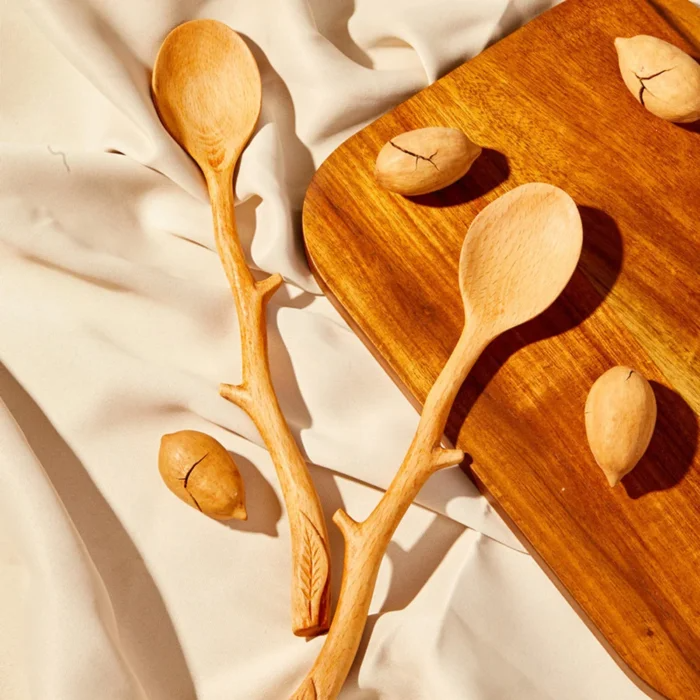
If you’ve been cooking with the same plastic spatulas and nylon spoons for years, a new study might make you think twice. In 2025, the US Congress passed the Microplastic Safety Act, requiring the FDA to study the health impact of microplastics in food and water — a direct response to growing evidence that plastic cooking tools are releasing tiny particles directly into our meals.
It’s a question more American home cooks are asking: are wooden kitchen utensils actually safer?
The short answer is yes — and the reasons go well beyond “natural feels better.” This guide covers the science, the common myths, and everything you need to know to make the switch to wooden, bamboo, and natural utensils for good.
What the Research Says About Plastic Utensils and Microplastics
Microplastics are tiny plastic fragments under 5mm in size — often invisible to the naked eye. We’ve known for years they exist in oceans and soil. What’s newer, and more alarming, is that they’re also showing up on our plates.
A 2023 study published in Environmental Science & Technology found that plastic cooking utensils — especially those used with hot food — shed microplastic particles directly into meals. When a plastic spatula scrapes a hot pan, heat and friction cause tiny fragments to break off. The harder you cook, the more particles end up in your food.
The Microplastic Safety Act of 2025 specifically called out this issue, noting that children, pregnant women, and people with autoimmune conditions face elevated risk. The FDA study is still ongoing, but the concern is real enough that Congress acted on it.
Wooden utensils don’t carry this risk. They’re made from a single natural material — no polymers, no coatings, no synthetic binders — which means there’s nothing to shed into your food when they heat up.
The Bacteria Myth: Are Wooden Spoons Unsanitary?
This is the most common objection people raise, so let’s address it directly.
The myth: Wood is porous, so it traps bacteria and is harder to clean than plastic.
The reality: Research from UC Davis found that bacteria introduced to wooden cutting boards actually died off and could not be recovered after several hours — while bacteria on plastic boards survived and could be found deep in scratches. The same principle applies to wooden spoons and spatulas.
Wood has natural antimicrobial properties that most people don’t know about. Teak wood, in particular, contains natural oils and silica that create an inhospitable environment for bacterial growth. These oils also give teak its characteristic water resistance and longevity.
The key caveat is care. Wooden utensils that are cracked, deeply scored, or improperly maintained can harbor bacteria in those gaps. The solution is simple: wash with warm soapy water immediately after use, dry thoroughly, and oil periodically. More on that below.
Wooden vs. Plastic Utensils: A Head-to-Head Comparison
| Feature | Wooden Utensils | Plastic/Nylon Utensils |
|---|---|---|
| Microplastic risk | None | Sheds particles when heated |
| Chemical coatings | None (natural) | Often includes BPA or synthetic finishes |
| Nonstick pan safety | Excellent — won’t scratch | Depends on type; nylon can melt |
| Heat resistance | High | Varies — some melt, some warp |
| Bacteria | Natural antimicrobial properties | Scratched plastic harbors bacteria |
| Lifespan | Years to decades with care | Months to a few years |
| Environmental impact | Biodegradable, renewable | Petroleum-based, non-biodegradable |
| Cost over time | Low (lasts longer) | Higher (replace more frequently) |
The only categories where plastic sometimes wins: dishwasher compatibility and initial price. But once you factor in how long quality wooden utensils last — and the hidden health costs of microplastics — the math shifts quickly.
Teak vs. Acacia: Which Wood Is Best for Kitchen Utensils?
Not all wooden utensils are equal. The wood species matters a great deal for durability, safety, and performance. These are the two you’ll encounter most often, including in our collections at Natural Utensils:
Teak Wood
Teak is considered the gold standard for kitchen utensils, and for good reason. It’s one of the densest hardwoods available, with a natural silica and oil content that makes it:
- Naturally water and moisture resistant
- Heat tolerant — won’t warp or crack near a hot stove
- Slow to absorb bacteria and odors
- Self-conditioning — the natural oils reduce how often you need to re-oil
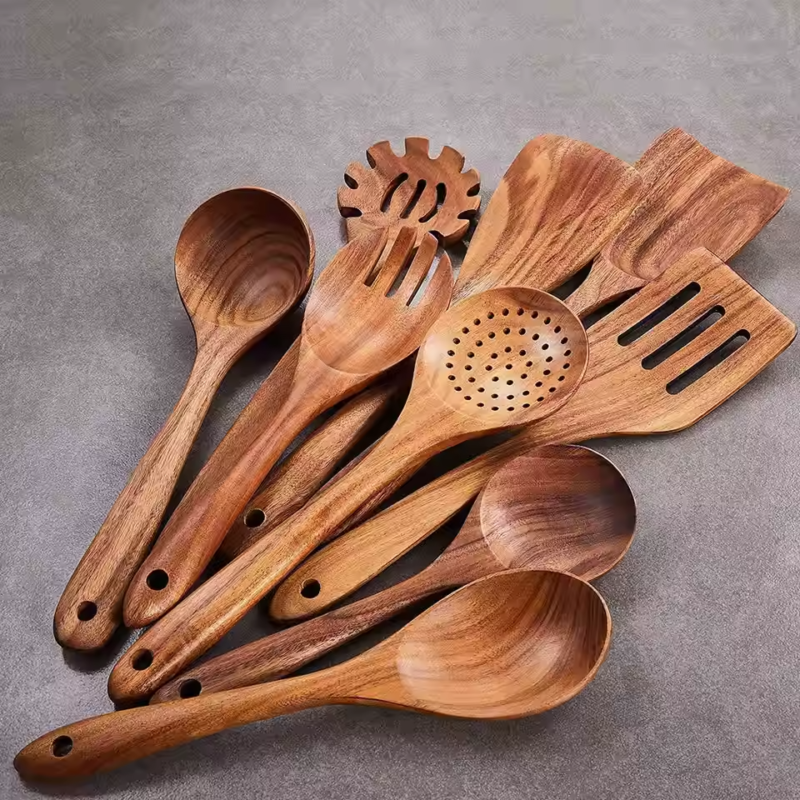
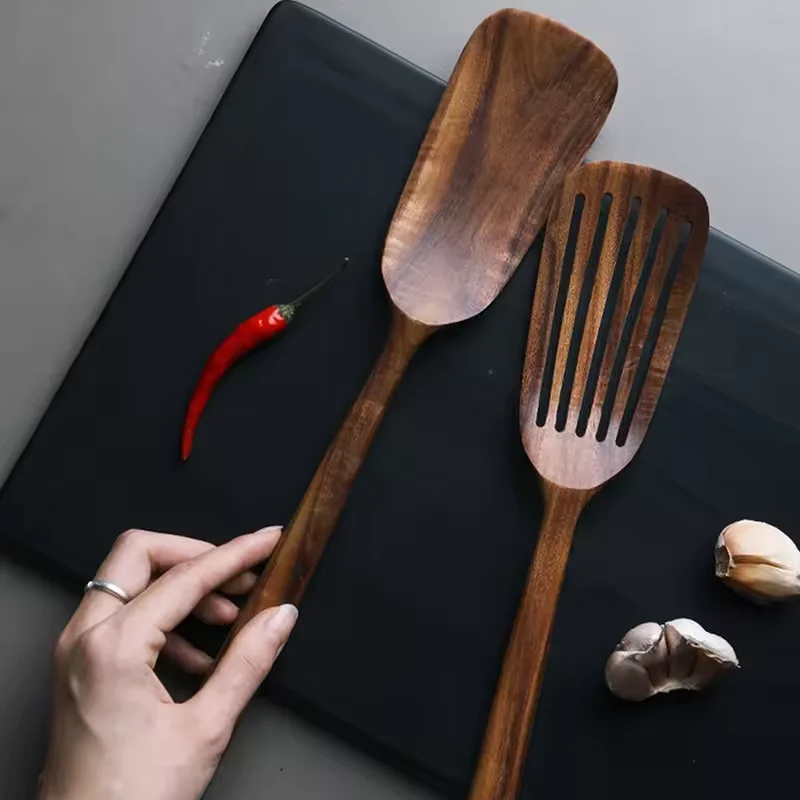
Teak is the wood we use in our Organic Teak Wooden Turner Set and our 1–9 Piece Wooden Kitchen Utensils Set. If you’re doing heavy daily cooking and want something that genuinely lasts, teak is the choice.
Best for: Everyday cooking, nonstick pan users, anyone who wants minimal maintenance.
Acacia Wood
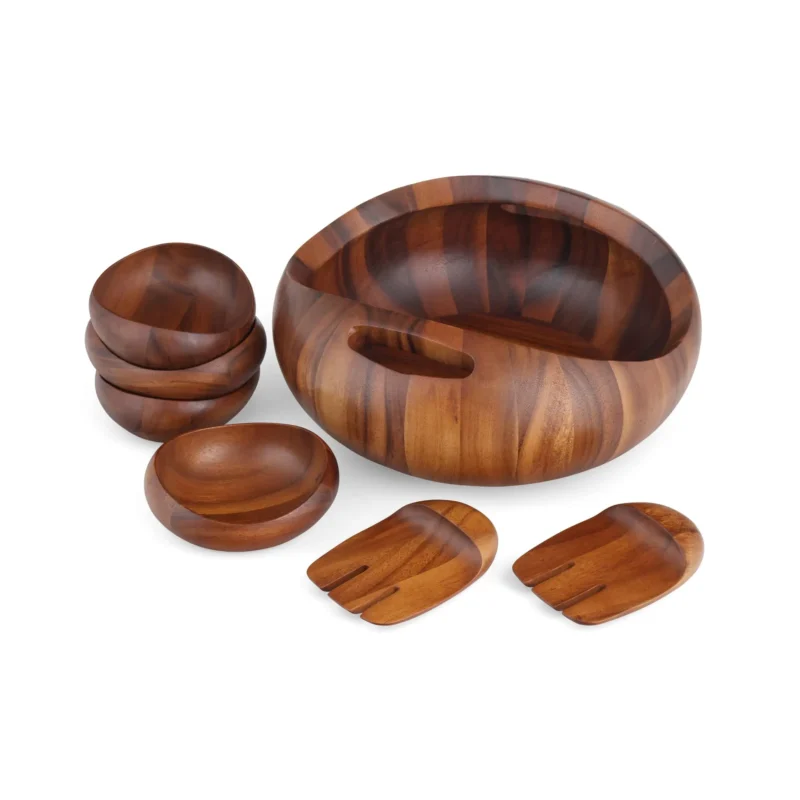
Acacia is a close second. It’s slightly more affordable than teak but still a very hard, dense wood that handles kitchen heat and moisture well. Acacia tends to have more visual variation in grain, which many people love aesthetically.
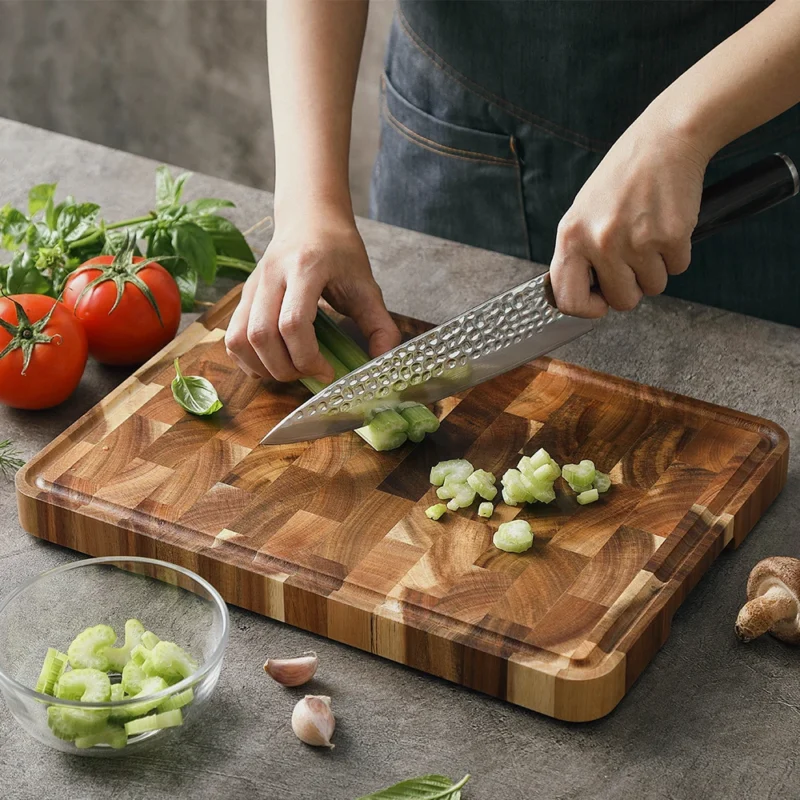
It’s slightly more porous than teak, which means it benefits from more frequent oiling — but with that care, it performs beautifully. Our Premium Acacia Wood Cutting Board and several of our serving trays use acacia for exactly this reason: the natural grain patterns make every piece unique.
Best for: Serving boards, trays, decorative kitchenware; cooks who enjoy the ritual of wood care.
What About Bamboo?
Bamboo is technically a grass, not a wood — but it deserves a mention here. It’s one of the fastest-growing plants on earth (some species grow several feet per day), which makes it extraordinarily renewable and eco-friendly. Bamboo utensils are lighter than teak or acacia and typically less expensive.
The trade-off: bamboo is harder and more brittle than teak, and some bamboo products are bonded with adhesives during manufacturing. Look for solid bamboo pieces rather than laminated ones. Our Artisan Bamboo Products use traditional solid bamboo construction.
Are Wooden Utensils Safe for Nonstick Pans?
Absolutely — and they’re actually the preferred choice for nonstick and ceramic-coated cookware.
Metal utensils scratch nonstick coatings, which does two things: it degrades the pan’s performance, and it releases coating particles into your food. Plastic/nylon utensils are softer than metal but can still melt at very high temperatures, and as noted above, they shed microplastics during normal cooking.
Wooden utensils are the safest option for nonstick pans because they’re firm enough to do the job, but smooth and slightly yielding enough that they won’t damage the coating. Teak and acacia in particular have a naturally smooth grain that glides across pan surfaces without catching or scratching.
If you’ve invested in a good set of nonstick or ceramic pans, wooden utensils are the single best way to extend their life.
How to Care for Wooden Kitchen Utensils
One reason people hesitate to switch to wood is the perception that it’s high-maintenance. It isn’t — but it does require a few simple habits different from plastic:
Do:
- Wash with warm water and mild dish soap immediately after use
- Dry thoroughly with a towel and then air dry upright (never flat, as moisture can pool)
- Oil every 1–3 months with food-grade mineral oil, beeswax, or coconut oil — this keeps the wood from drying out and cracking
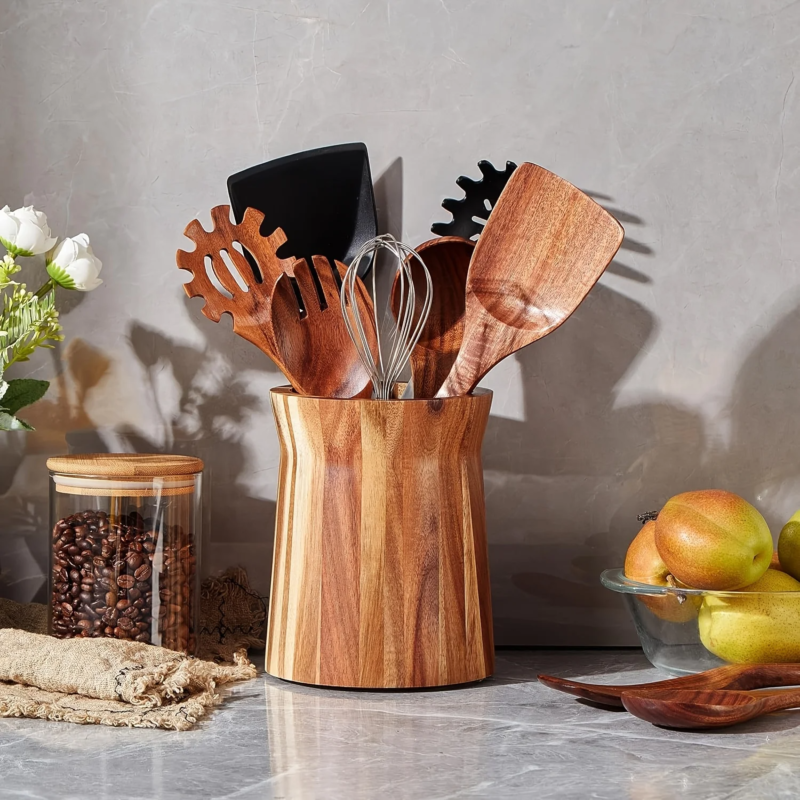
- Store in a utensil holder where air can circulate (our 360° Rotating Wooden Utensil Holder is perfect for this)
Don’t:
- Put wooden utensils in the dishwasher — the heat and sustained moisture causes cracking and warping
- Soak in water
- Leave sitting in a pan of liquid or on a wet counter for extended periods
That’s genuinely it. Most people find the oiling process takes less than five minutes and only needs doing a few times a year. The payoff is utensils that last a decade or more rather than months.
The Environmental Case: Why Switching Actually Makes a Difference
Americans throw away roughly 100 billion plastic items per year. Plastic utensils are a small but real part of that — they chip, warp, or stain after a year or two of use and typically go straight to landfill.
Wooden utensils from sustainably sourced teak or acacia, by contrast, are biodegradable, made from renewable resources, and last long enough that one good set can replace four or five rounds of plastic replacements over the same period.
The cumulative math matters. One household switching to quality wooden utensils eliminates dozens of plastic pieces from the waste stream over a decade. Multiply that across a neighborhood, a city, a country of 330 million people — and it adds up.
This is the bet behind Natural Utensils: that beautiful, functional natural kitchenware isn’t a luxury, it’s the practical choice once you think past the first price tag.
Frequently Asked Questions
Are wooden spoons safe to use with hot food? Yes. Wood doesn’t conduct heat, which means the handle stays cool to the touch even when you’re stirring something hot. Teak and acacia are also heat-resistant at the bowl/head of the spoon, so they won’t warp or melt the way plastic can at high temperatures.
Can wooden utensils go in the dishwasher? No. The repeated exposure to high heat, steam, and water causes wood to crack, warp, and splinter. Always hand wash and dry thoroughly.
Are wooden utensils safe for babies and children? Yes — in fact, they’re a better choice than plastic for children specifically. With plastic utensils facing increasing scrutiny over BPA and microplastic shedding, natural wood with no synthetic coatings or additives is the cleanest option for feeding little ones.
How do I know if my wooden spoon needs to be replaced? Look for deep cracks, significant splitting, or a rough/hairy texture that doesn’t smooth out with oiling. Surface scratches are normal and harmless. If your utensil is deeply cracked or has splintered sections, it’s time to retire it — but with proper care, quality teak or acacia should last many years before that point.
Do wooden utensils stain? They can absorb color from strongly pigmented foods like turmeric, tomato sauce, or beets, especially when new. This is purely cosmetic and doesn’t affect safety or performance. The staining tends to diminish with proper oiling and becomes part of the character of a well-used wooden kitchen.
Is bamboo better than wood for kitchen utensils? It depends on your priorities. Bamboo is more sustainable (faster growing) and lighter, but teak and acacia are generally more durable and moisture-resistant for cooking use. For everyday cooking tools like spatulas and spoons, we favor teak. For serving ware, decorative pieces, and eco-focused gifting, bamboo is an excellent choice.
Ready to Make the Switch?
The move from plastic to natural wooden utensils is one of those changes that feels small but has outsized effects: on your health (no more microplastics in your cooking), your cookware (nonstick pans last longer), your kitchen (natural materials age beautifully), and the planet (biodegradable, renewable, long-lasting).
At Natural Utensils, everything we sell is made from natural materials — wooden, bamboo, and coconut — with no synthetic coatings, no plastic components, and no compromise on quality. Free worldwide shipping on orders over $75.
👉 Browse our Wooden Utensils Collection 👉 Explore Wooden Gift Sets 👉 Shop Artisan Bamboo Products